Community Artist, Speed-Painter, Sculptor - commissions welcome


John Howie sculptural installation - Lochgoin Covenanters’ Museum
An atmospheric new sculptural installation at Lochgoin Covenanters’ Museum near Fenwick on the border of Ayrshire and East Renfrewshire celebrates the life and literary work of a remarkable man: John Howie (1735 - 1793), a humble farmer without much formal schooling, whose devout passion for Scotland’s religious history inspired him to become a renowned biographer. In particular, he wrote about the lives of the Covenanters who, a hundred years earlier, had been forced to congregate in secret Conventicle gatherings while being persecuted for their Presbyterian faith by King Charles I in the name of religious conformity.
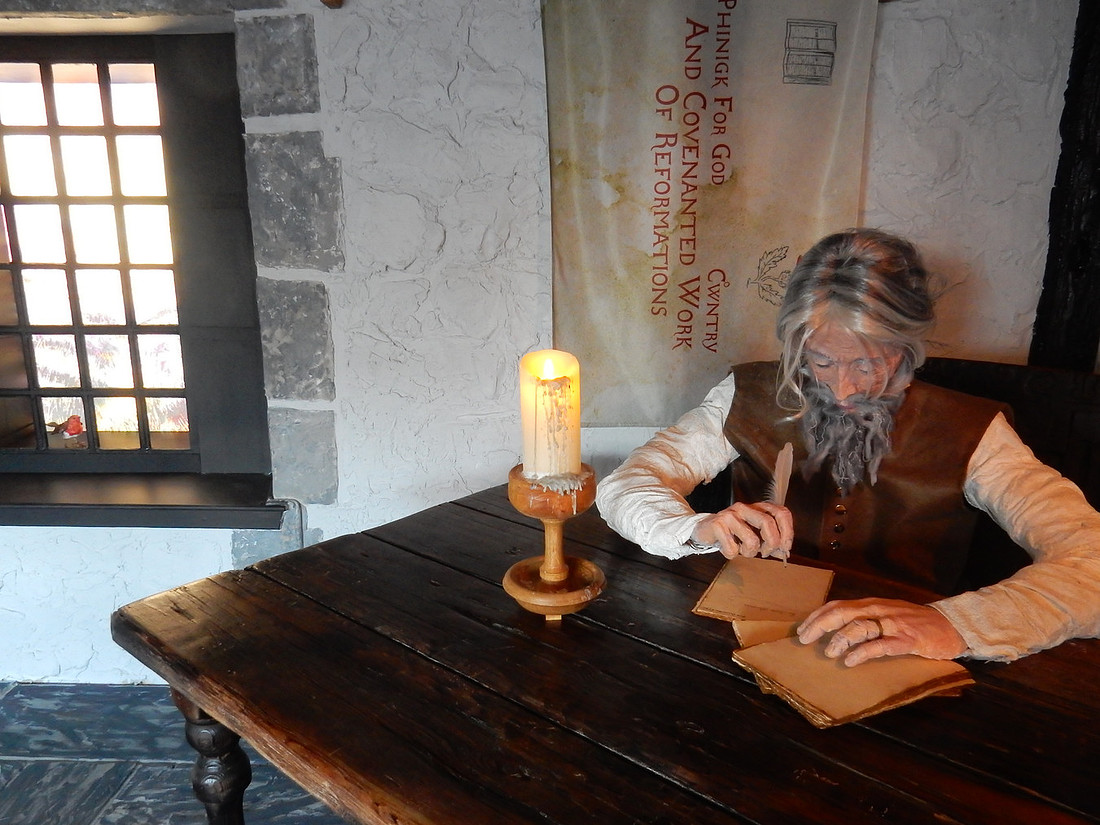
I was asked by the museum trustees to create a realistic life-size figure to represent John Howie at his writing desk, based on research notes gleaned from Reverend Dr Robert Buchanan’s ‘biographical sketch of John Howie’ which introduces the 1876 edition of Howie’s most enduring work: the Biographia Scoticana, better known as The Scots Worthies.
I begin by sculpting a wire frame, starting with the shoulders, effectively drawing the shapes of each body part in three dimensions. Strands of thinner wire bind and anchor each piece to another, resulting in a strong but flexible composite. I base the structure on a human skeleton, including a rudimentary ‘rib cage’ and ‘skull’. The head and hands require the most intricate sculpting, even at the wire stage, to ensure that the figure will look convincingly like he is writing. Within a few days, the sculpture already has a remarkable presence, even though it is entirely hollow and somewhat reminiscent of a robotic T800. It also begins to take on quite an obstinate character of its own! Stainless steel mesh is sculpted over the wire skeleton and stitched into place. Wire gives the piece strength and flexibility, allowing me to make precise adjustments to the pose.

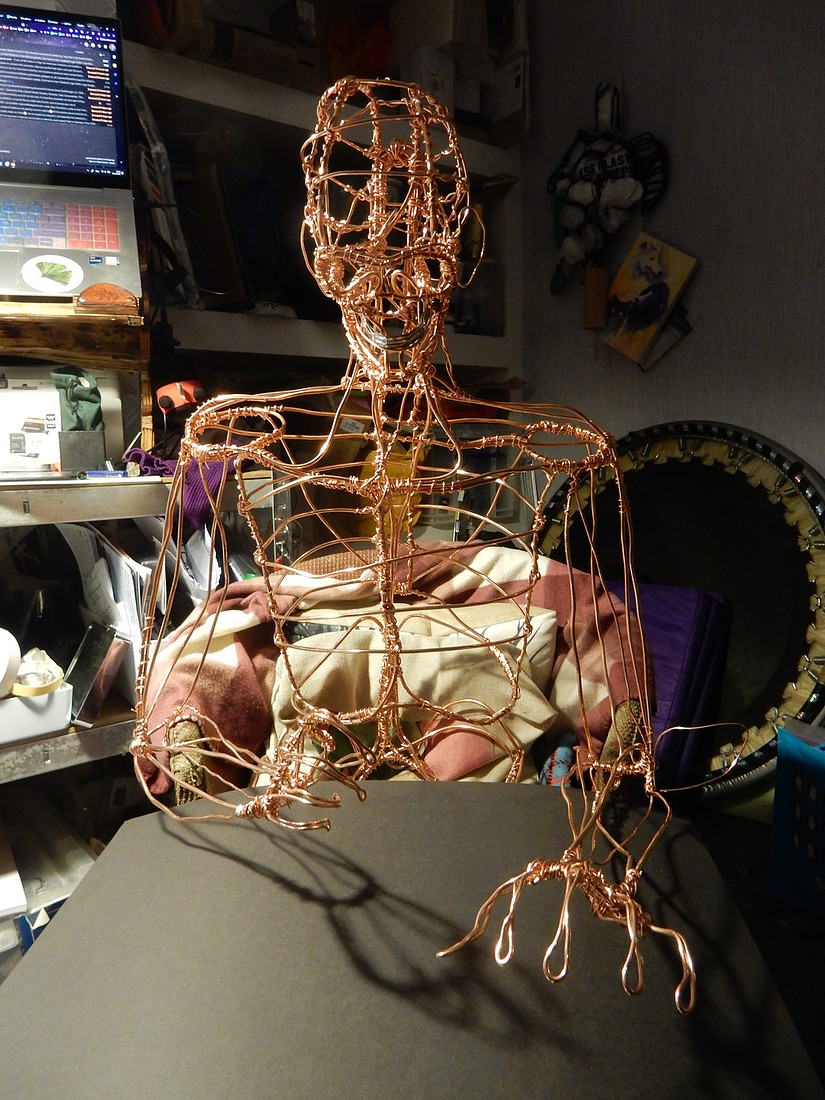
I begin fleshing out the sculpture, first using plaster bandage, which is traditionally used for setting broken bones, hence it fixes the positions of the fingers. It also coats the skull, ready for the next step.
I use Apoxie Sculpt which is a very strong air-dry clay medium to mould the flesh, nails and skin. By all accounts, John Howie suffered numerous ailments throughout his life, including smallpox, and also sustained a serious carriage accident, all of which would have left scarring, so I add lots of texture on the skin.
At this point, I start a new pot of Apoxie Sculpt, which is black instead of pale grey - an interesting plot twist! It will all be painted later in any case. Semi-spherical doll’s eyes placed in the eye sockets make the sculpture look rather comical, until I add eyelids. The rest of the face takes shape and begins to look quite characterful. Every face tells a story. Mr Howie’s face would have likely borne permanent smallpox scarring from his youth. A quill feather fits neatly between finger and thumb.
Once the Apoxie Sculpt is dry, the face and hands are painted. My sculpting method for this life-size figure is identical to the way I work on miniature figurines, just scaled up.
Spirals of wire help to flesh out each of the limbs before adding a ‘skin’ of mesh to support more plaster bandage, which will form the stockings, shirt and breeches. The figure remains hollow inside though now appears quite solid from the outside.
A pair of rubber boots will form the basis of Mr Howie’s jackboots. I paint the breeches and then come back to the boots, adding wire supports to extend them where necessary. Felt fabric is moulded around each boot, painted to suggest worn leather and stitched or stapled in place. An 18th century waistcoat was long and would have covered the upper leg. I cut the whole garment out of a single sheet of felt, lay it around the figure and trim where needed. Mini bulldog clips are perfect for marking out where to add buttons and pockets before I begin sewing everything together in situ. It is very helpful to have Mr Howie on a makeshift wheelchair in order to access the sculpture from all sides. There are a lot of buttons to sew on: fourteen down the front, and three on each pocket.
I check his wig for size - Mr Howie would likely have had shoulder length hair tied up in a ponytail. I loosely needle-felt a beard, and make his eyebrows out of fluffy feathers and more needle-felted wool.
While all of this sculpture is in progress over the course of several weeks, my partner Jason and I have been busy transforming the space at the museum, ready for Mr Howie’s arrival, making it look more like the 18th century. We remove the stone effect wallpaper, mark out where the key-stones would have been for the window, and get creative with trowels and lots of plaster. Sculpting each stone and smoothing out the surface is a very meditative experience. We get through about fifteen tubs of pre-mixed plaster, which is ideal for the heritage environment as it creates minimal dust.
Realistic PVC beams add a great deal of character and atmosphere to the installation. We paint the wall and ceiling, add woodgrain, and install a shelf. Jason adapts a pair of realistic electric candles, creating bespoke lathed wooden candlesticks as supports and adding authentic dripped wax.
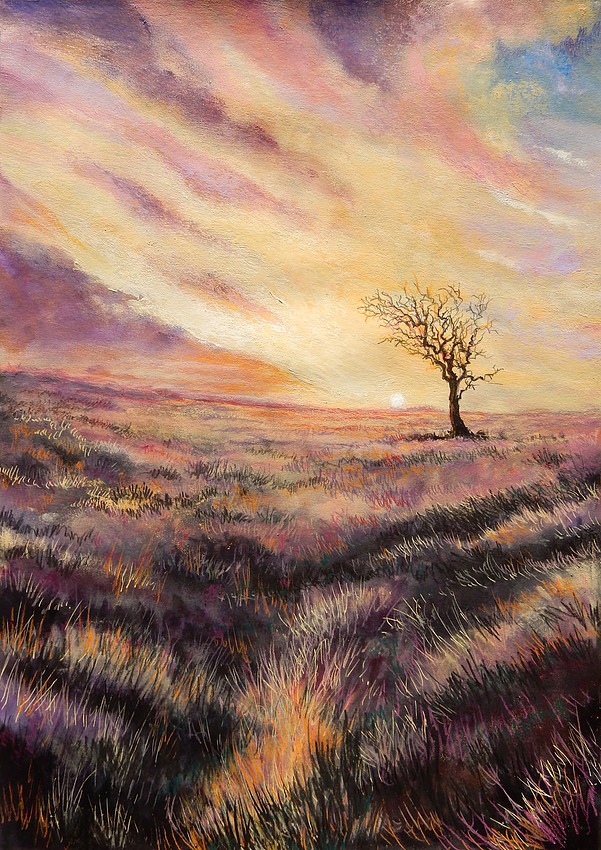
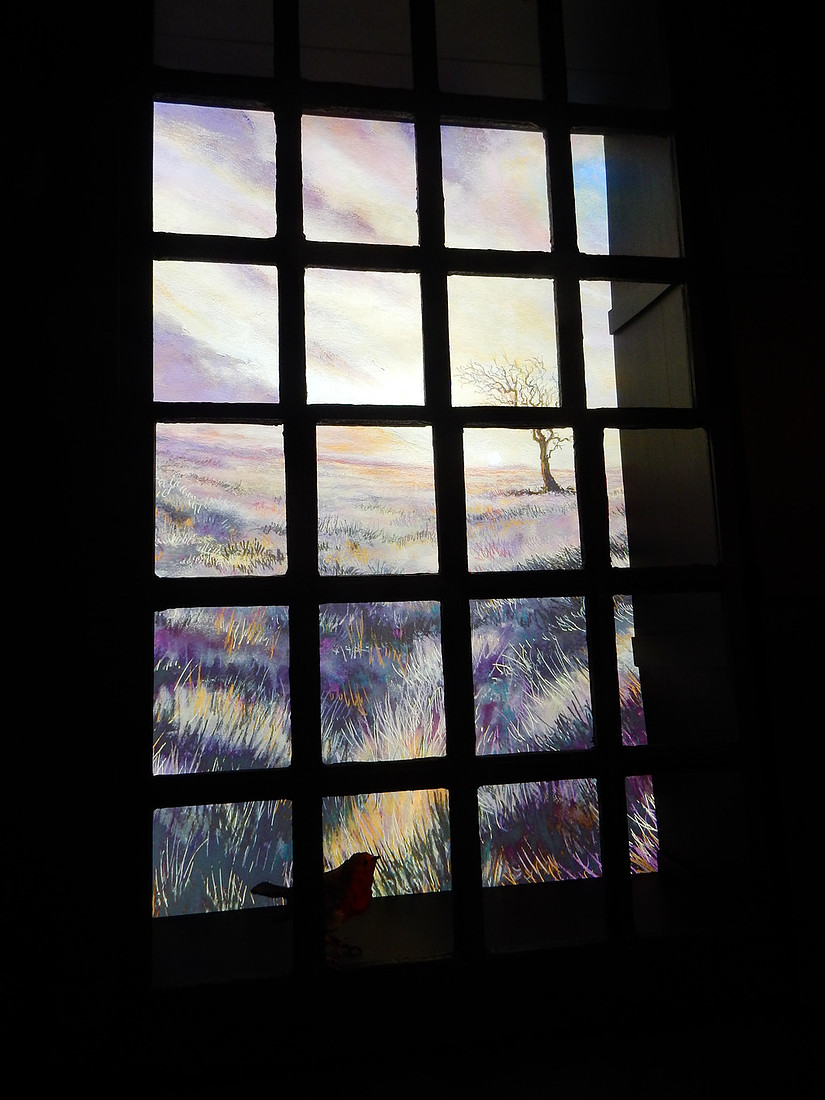
Meanwhile, to make the modern window look more in keeping, we need to first block out the existing view (which includes some of the wind turbines of Whitelee Wind Farm) and replace it with a lightbox. I create a bespoke painting of an evocative moorland sunrise that John Howie might have seen looking out in the 1700s. A kitchen sponge and acrylic paint create a soft, atmospheric ambience. Finer detail is added with coloured pencil, acrylic ink markers, and a palette knife for texture. We fit a translucent print of this painting into the lightbox and install it in the window.
The window frame is cut out of foamboard. 18th century glass window panes would have been much smaller than those in modern windows. I use plaster bandage to add texture and dark brown paint to make them look like wood. The window frame is spaced slightly away from the lightbox. I add a robin, sculpted out of wire and plaster bandage, perched on the windowsill.
Last but not least, I create a small portrait of John Knox, Reformation leader and founder of the Church of Scotland or the Kirk, whom Howie included in The Scots Worthies. Knox lived roughly two centuries before John Howie.
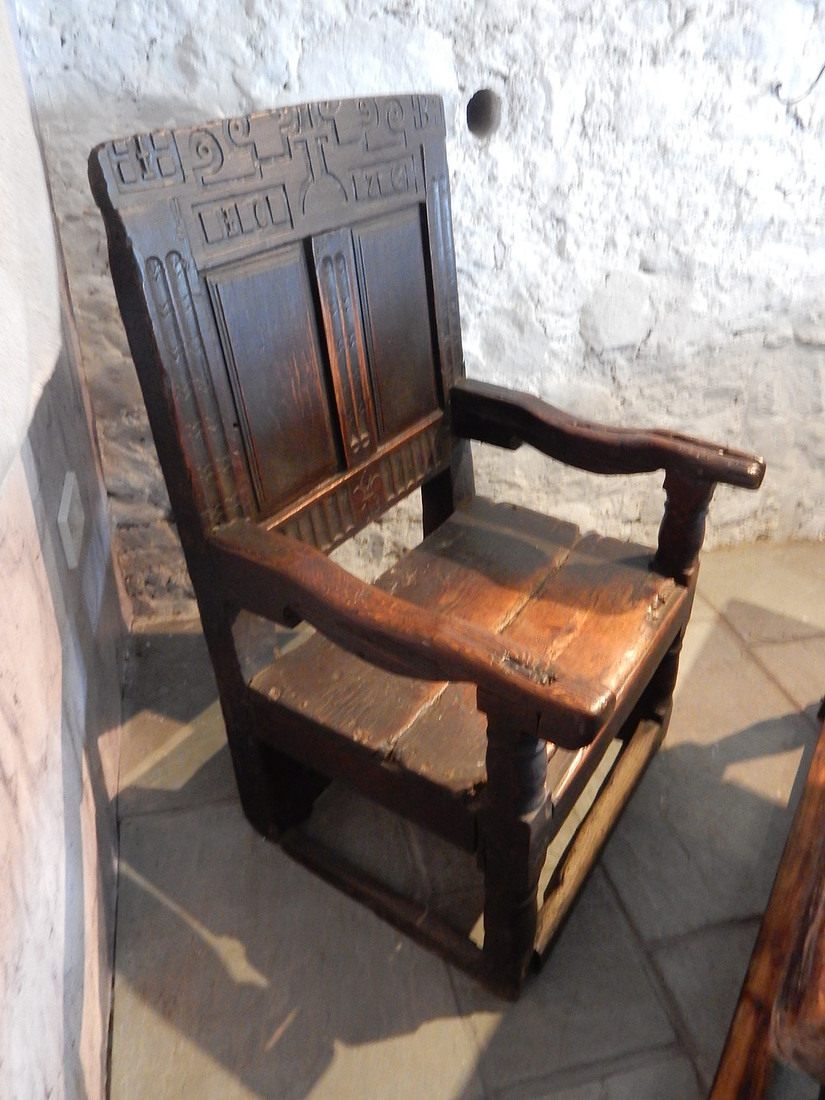
John Howie looks forward to welcoming you to his home on the farm in Lochgoin, which has been run by his ancestors since 1187 and is still farmed by his descendants to this day. The farmhouse was a noted refuge for the Covenanters and was searched by government soldiers on several occasions. Among Howie’s treasured possessions were a chair and sword that had belonged to Covenanter Captain John Paton a century earlier. The sculpture of Mr Howie now sits on this same chair.
The What3Words location of the museum is ///mushroom.crystals.overhear and lies within the area of Whitelee Wind Farm. It is open daily from 9 till 5. Admission is free. Donations to the Lochgoin and Fenwick Covenanters Trust are welcome. A stone obelisk memorial to John Howie stands opposite the museum.
In closing, just a polite reminder to refrain from touching the installation as the artwork is fragile. Many thanks for watching.

Kelloholm
SANQUHAR
Dumfries and Galloway
DG4 6SL
United Kingdom


